


People call the Medieval period the Dark Ages. There is no denying that all periods in history have terrible and dark things about them. But the Medieval period was not all bad, and saying as such paints the period in too broad of strokes and it misses some of the nuance of what life was like during that time. There were a lot of developments happening during that time across the world, in math, science, art, and religion. Since the Medieval period is such a large span of time, many different styles took shape. In this post, we will explore just a few examples.
In early Medieval depictions of the Nativity, Mary is seen laying beside the manger, or holding the baby Jesus.
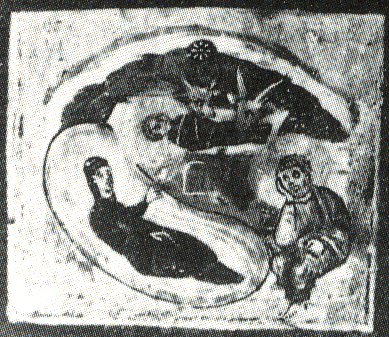
This image is a detail from the Sancta Sanctorum Reliquary box from the sixth century. This arrangement, with the ox and donkey “feeding” from the manger (a reference to the Eucharist), as well as Mary laying near the baby and Joseph off to the side, would be common for many years in the Medieval period.
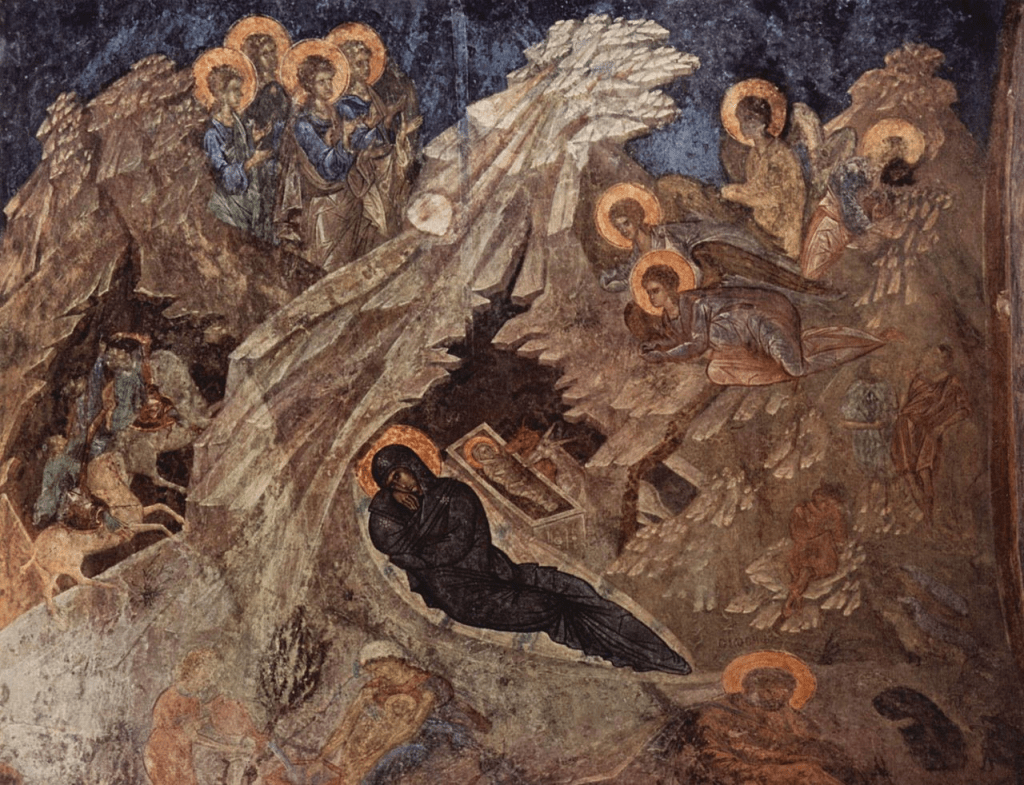
Above is a fresco from Greece, from around the mid-fourteenth century. Often, the baby would be shown laying not in a manger, but on a sort of raised table or stone, a reference to his eventual death and burial. His being wrapped in swaddling clothes was also a reference to his eventual death and being wrapped in burial clothes. Such a foreboding message to be conveyed in a painting of a birth of a child!
The way the Nativity was depicted changed after the mystic Bridget of Sweden (1304-1373 A.D.) wrote of a vision she had. In her vision, she sees Mary give birth to the baby Christ in a quick and painless manner, unassisted by anyone. The baby glowed with a heavenly light, and his parents worshipped him. This vision, and other writings from the 14th century depicted the birth as mess free and painless, all of heaven and earth coming close to worship the baby Christ, knowing from the light emanating from him that he was God made man.
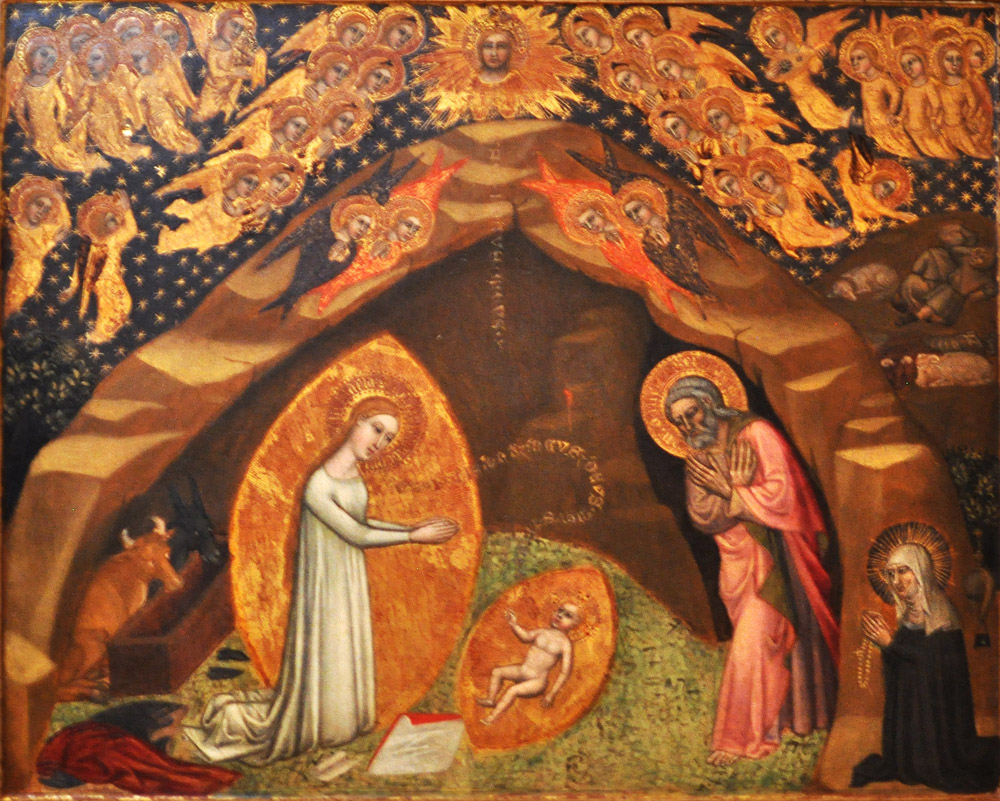
The image above is one of the earliest depictions of the vision of Bridget of Sweden. It was made by Niccolo di Tommaso sometime in the late 1300s (exact date unknown). Mary and the baby glow with holy light, the same light that shines from the angels in the sky coming to announce his birth. Bridget looks on, kneeling in worship, and the ox and the donkey look on in wonder as well. This depiction of worshipping Christ and offering him reverence persists even now.
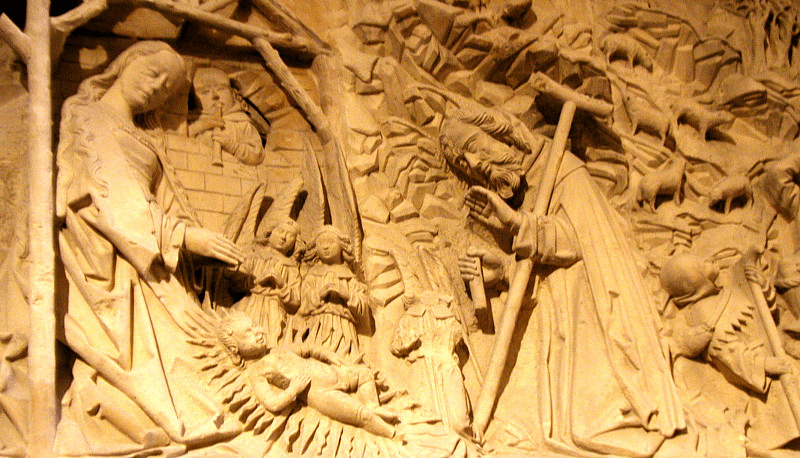
The image below is a detail from a relief carving on St. Anne’s Chapel in Spain, made in the 15th century. It shows the earthly parents of Christ, along with angels, bowing before the glowing child. A shepherd plays a flute in the background, as if his joy and excitement cannot be contained, and he bursts forth with a joyful noise.
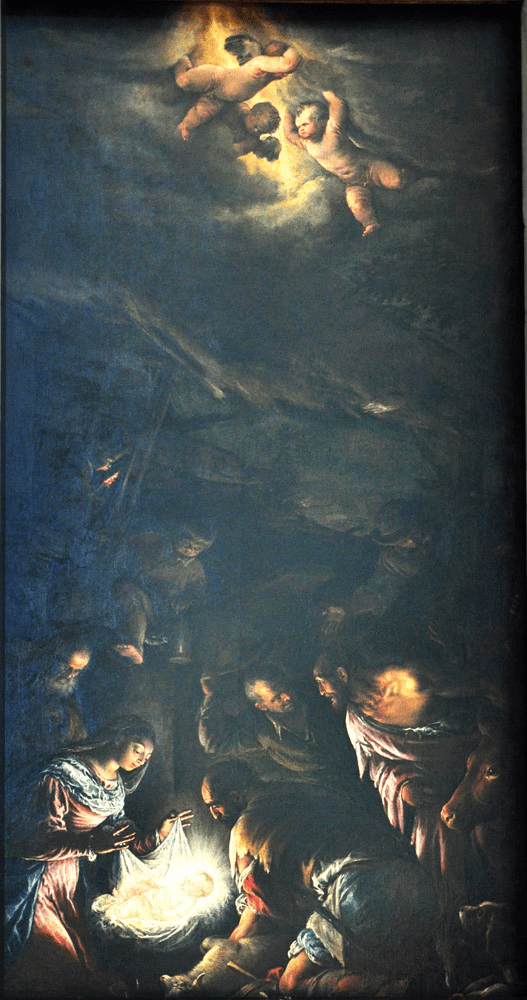
This next image is The Adoration of the Shepherds by Jacopo de Bassano, painted in 1582. I like this one a lot, the only light coming from the baby and the angels in the sky above, darkness being pushed back by Christ’s holiness. This painting is from the Renaissance, not the Medieval period, but I included it anyway as it still fit the theme.
I hope you enjoyed this very brief exploration of Medieval Nativity art. While the Medieval period is known as a period of darkness and death, the Nativity depicted in art during this time contrasts the darkness with light, nourishment, and joy. Because of his birth, we no longer have to fear death and darkness, but have a light pointing to the way out. I hope you will ponder this during the Christmas season.
Once again, thanks so much to Christian Iconography for compiling and explaining so many works of art. Check them out if you want even more beautiful (and weird) Christian art through the ages. And thanks to the many artists who have gone before, who have made such lovely, detailed works we can all still enjoy today.
SOURCES:
“The Sancta Sanctorum Reliquary Box: Detail; The Nativity.” Christian Iconography. https://www.christianiconography.info/iconographySupplementalImages/crucifixion/sanctaSanctorum_nativity.html.
“Nativity of Jesus in Art.” Wikipedia. https://en.wikipedia.org/wiki/Nativity_of_Jesus_in_art#Byzantine_and_Orthodox_tradition.
“The Nativity as seen by St. Bridget of Sweden: A Mystic’s Vision of the First Christmas.” Laudate Mariam. https://laudate-mariam.com/blogs/laudate-mariam-blog/the-nativity-as-seen-by-st-bridget-of-sweden-a-mystic-s-vision-of-the-first-christmas?srsltid=AfmBOopTtBLAbSrRqebrCxtTA2clGgynlEjrzEyuDE8yTTVrBvHjYQzi.
“The Vision of St. Bridgid of the Nativity.” Christian Iconography. https://www.christianiconography.info/sicily/nativityVatMus.html.
“The Nativity.” Christian Iconography. https://www.christianiconography.info/spain2005/nativityBurgos.html.
“The Adoration of the Shepherds.” Christian Iconography. https://www.christianiconography.info/Edited%20in%202013/Italy/adorationShepherdsBassano.html.

Leave a Reply