


Last year, I taught a mini series on Christmas traditions around the world for the youth group I was helping to lead. I thought I would share the lessons I wrote here (with a few modifications) for a couple reasons. Hopefully someone will enjoy reading about these topics as much as I enjoy studying and writing about them. It also helps me to feel more in the spirit of the season and connected to the history of Christianity and the church. Liturgy, traditions, and history make Christianity and the holidays so much richer and special to me. I hope you enjoy!
Some of the earliest Christian art can be found in catacombs and on sarcophagi, but even so a lot of this art does not appear until the 4th century. The Roman Catacombs, where a lot of early Christians were buried, where often used as gathering places for memorial services of the dead. Art depicting stories from the Bible would decorate the walls and ceilings of the catacombs of the sides of sarcophagi. Much early Christian art was full of symbolism, a way for people to know the stories told in the art without needing to be able to read.
Early Nativity scenes focused on the birth of Christ as a fulfillment of prophecies found in the Old Testament. They would showcase the ox and the donkey coming to visit Christ in the manger, showing the animals knew Christ before people did. Isaiah 1:3 states “The ox knows its master, the donkey its owner’s manger, but Israel does not know, my people do not understand.”

This is a detail image taken from the Sarcophagus of Stilicho from the third or fourth centuries. The ox and donkey are positioned facing the manger, their feeding trough. This positioning also symbolized that the ox and donkey fed on Christ, an early representation of the Eucharist. As the ox and donkey feed from the manger where Christ was laid, so too do Christians gain their nourishment from Christ’s body.
I find it interesting that even in these earliest art works, ones that show Christ’s very first moments, they are pointing towards his death. But not only his death, but also his power to give the Christian new life by relying on and following him. The birth of Christ was a moment in time, a single instance of something so normal, but it was also a compass, a map, to another event that would forever change the world.
It wasn’t until after the fourth century that other figures in the Nativity scene became more common. Since fulfillment of prophecy was highlighted in the early works, other people were not as important. The exceptions to this were Mary, a shepherd, or the Magi.

In the above example, Mary sits to the side of the manger, while the donkey eats from the manger (pointing towards the Eucharist). This is a sarcophagus fragment from the fourth century.
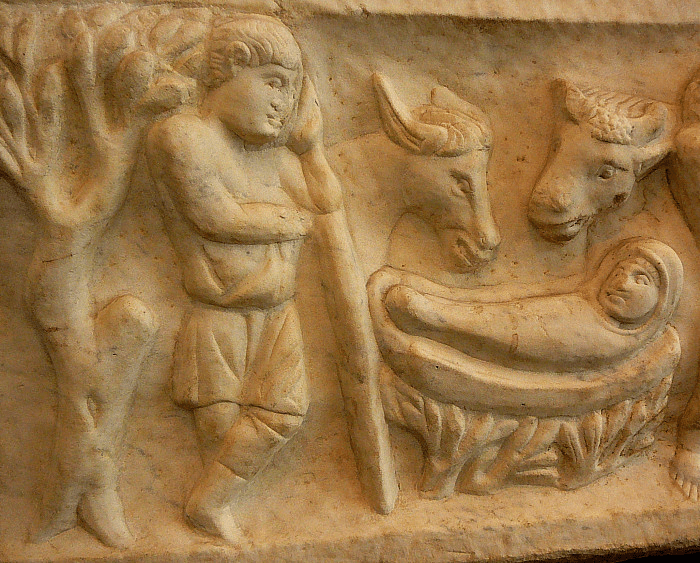
Another example shows a fragment of the sarcophagus of Marcus Claudianus from around 330 A.D. This Nativity scene once again shows the ox and donkey, while a shepherd stands to the side.
I find Christian art so interesting. From ancient times to present day, Christians have been showcasing their talent to create something beautiful while also helping to teach others about Christ. It is interesting and sobering to look back on all those hundreds of years of art, to see what has changed and what has remained the same. Art makes us think, it teaches us something about the world, about other people. I hope by reading this little exploration or art, you have come to better appreciate the skills and talents of those who have come before us. I hope you learned something new, about Christianity or art.
Many thanks to the site Christian Iconography. I stumbled upon it by accident one day, and it has been such an interesting and helpful source. It has many more examples of very early Christian Nativity scenes that I did not include here. Please check it out if you are interested in that, or in Christian art in general.
https://www.christianiconography.info/
As always, more to come!
SOURCES:
Paul, J. Steven. “The Roman Catacombs.” In Search of Christian Origins. August 13, 2023. https://insearchofchristianorigins.com/the-roman-catacombs/.
Isaiah 1:3. (New International Version).
“The Nativity Tympanum on the Sarcophagus of Stilicho.” Christian Iconography. https://www.christianiconography.info/Wikimedia%20Commons/nativitySarcophagusStilicho.html.
“Paleo-Christian Sarcophagus Fragment with the Nativity.” Christian Iconography. https://www.christianiconography.info/sicily/nativityFragPio.html.
“The Sarcophagus of Marcus Claudianus: Detail, The Nativity.” Christian Iconography. https://www.christianiconography.info/palazzoMassimo/mcSarcophagus.Nativity.html.

Leave a Reply